
In the glittering promotional videos of Gujarat Tourism, Rogan Art is showcased as a miracle of survival. But behind the “Tree of Life” motifs lies a darker reality of exclusion. By crowning a single family as the sole custodians of this 1,500-year-old craft, the Gujarat government is committing a cultural crime—and Ashish Kansara is the master artisan they are trying to forget.
For decades, the narrative of Rogan painting—a technique of using boiled castor oil and natural pigments to create “liquid threads” on fabric—has been funneled through one specific lineage in Nirona. While their work is undoubtedly significant, the state’s refusal to acknowledge any other practitioner has created a dangerous monopoly. This favoritism doesn’t just hurt artists; it strangles the diversity and evolution of the art form itself.
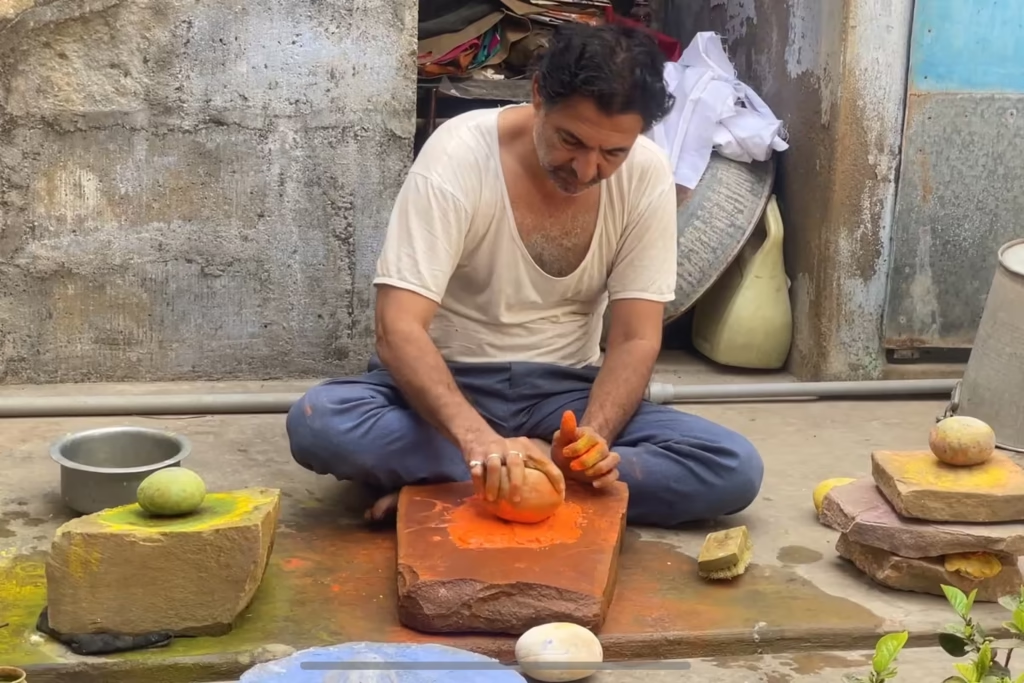
The Erased Legacy: Who is Ashish Kansara?
In the village of Madhapar, Ashish Kansara continues a tradition that predates modern political patronage. As the last Hindu custodian of Rogan painting, Kansara represents a vital historical link. His lineage proves that Rogan was once a widespread regional heritage of Kutch, practiced across communities before it was “branded” as a family heirloom.
Despite his mastery, Kansara has been systematically bypassed for State and National awards. Yet, his credentials are ironclad:
- The GI Tag Authority: Ashish Kansara is a legally recognized Authorized User of the GI (Geographical Indication) Tag (AU/35946/GI/718/1). This means the Government of India acknowledges his work as authentic Kutch Rogan, even while the Gujarat Government ignores him.
- The Innovator of Deities: While the “monopoly” school focuses on traditional florals, Kansara achieved the nearly impossible: using the viscous, stringy Rogan paste to paint intricate portraits of Hindu deities. His depictions of Lord Krishna, Ganesha, and Tirupati Balaji are technical marvels that require a level of precision rarely seen in the craft.
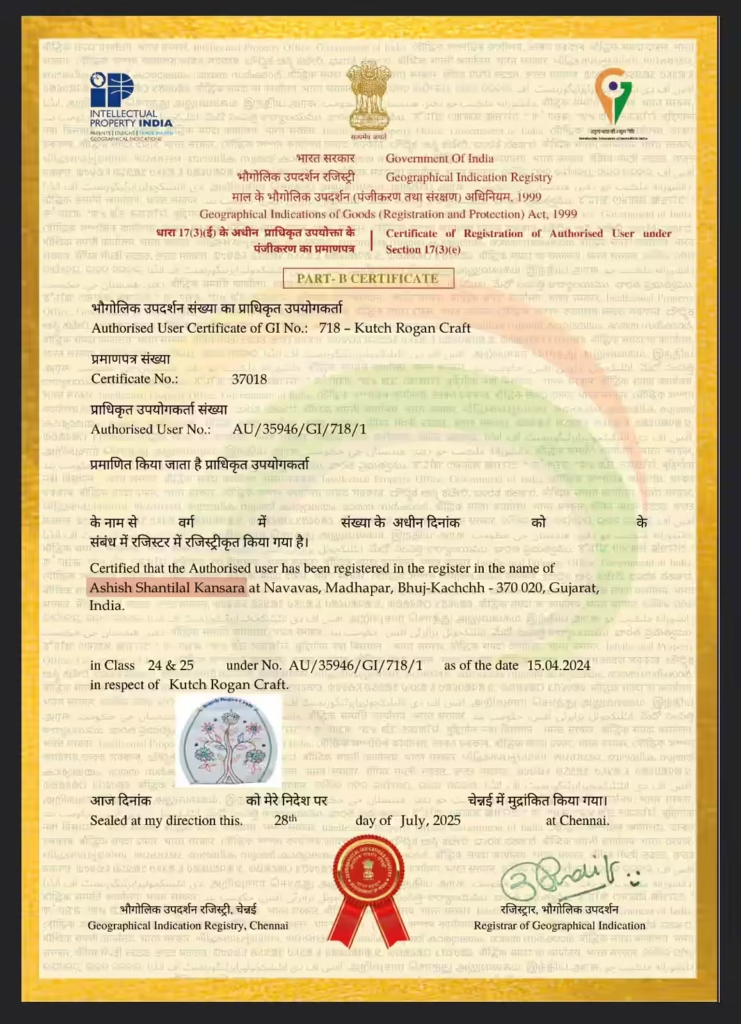
The Triple-Mastery of Ashish Kansara: A Heritage in Three Forms
While the Gujarat government focuses its energy on promoting a single, simplified version of Rogan art, Ashish Kansara stands alone as the master of all three distinct, historical techniques. To ignore him is to ignore two-thirds of the art’s entire technical history.
Rogan Chhap (The Pure Freehand):
This is the traditional “liquid thread” technique. Using only a metal stylus and the heat of his palm, Kansara creates intricate, symmetrical designs without any pre-sketching. His ability to render complex Hindu deities in this freehand style is a feat of precision that remains unmatched in the state.
Nirmika Rogan Chhap (The Rare Mould Printing):
This is a nearly extinct semi-mechanical process that the government has almost entirely forgotten. It utilizes “Biba” (hand-carved brass moulds) and a wooden pressure stick to transfer the Rogan paste onto fabric. Because the state only promotes freehand painting for its “spectacle,” this essential method of Rogan printing—vital for sarees and large-scale textiles—is on the verge of disappearing. Kansara is one of the last masters keeping these brass moulds alive.
Varnika Rogan Chhap (The Ancient Embellished Freehand):
Perhaps the rarest of all, this “very old” style is the most decorative. It involves a single-color freehand base that is then painstakingly layered with additional pigments and decorated with Mica (Abrakh) and Glitter. This technique produces a shimmering, festive effect that was historically reserved for the most elite Gujarat textiles.
A State-Sponsored Erasure
The “Cultural Crime” is not just about a missing award; it is about the narrowing of history. By only giving awards to those who practice basic freehand painting, the Gujarat government is effectively sentencing Nirmika (mold printing) and Varnika (mica-decorative) styles to death.
Ashish Kansara is the only practitioner in the world who holds the “DNA” for all three styles. If the state continues to protect a single-family monopoly while ignoring the man who preserves the full spectrum of Rogan history, they are not preserving Gujarat’s culture—they are editing it until it is unrecognizable.
How a Monopoly Kills Rogan Art
When a government decides that a 1,500-year-old art belongs to khatri family, they are effectively declaring all other masters “illegitimate.” This selective patronage is a death sentence for Rogan Art for three reasons:
- Economic Exclusion: The most damning evidence of this cultural crime is the total financial and promotional blockade against the Madhapar master. To this day, the Gujarat government has not conferred a single State Award upon Ashish Kansara, despite his status as a GI-authorized master and the world’s only artist preserving all three historical branches of the craft.
- Educational Stagnation: Ashish Kansara and his wife, Komal Kansara, have trained over 130 women, breaking the “family secret” mould to ensure the art survives in the community. Without government help, these training centres cannot scale.
- The Loss of Identity: If the “Hindu custodian” branch of Rogan art is allowed to wither away due to lack of recognition, we lose an entire chapter of our cultural history—one where different faiths and communities shared the same creative language.
“A tradition is not a museum piece to be guarded by one household; it is a living river that must be allowed to flow through many hands.”
The Demand for Accountability
The Gujarat government’s silence on Ashish Kansara’s contributions is no longer just “oversight”—it is a choice. To protect a monopoly is to kill the art. For Rogan painting to truly survive the 21st century, the state must move beyond its “one-family” marketing strategy and recognize the masters in the shadows.
Justice for Rogan Art means:
- Granting State Awards to Ashish Kansara based on his technical innovations and GI status.
- Including the Madhapar school in official tourism circuits and promotional films.
- Ending the “single-family” narrative in schools and cultural textbooks.
Ashish Kansara has the talent, the history, and the legal recognition. The only thing he lacks is a government that values artistic truth over political optics.
Pingback: Ashish Shantilal Kansara | Master of Kutch Rogan Art & GI Authorized User